
 Adult Medicine
 Behavioral Health
 Dental
 Endocrinology
 HIV/STD Screening & Treatment
 LGBTQ Services
 OB/GYN
 Pediatrics
 Pharmacy
 Senior Care
 Vaccinations & Immunizations
 Vision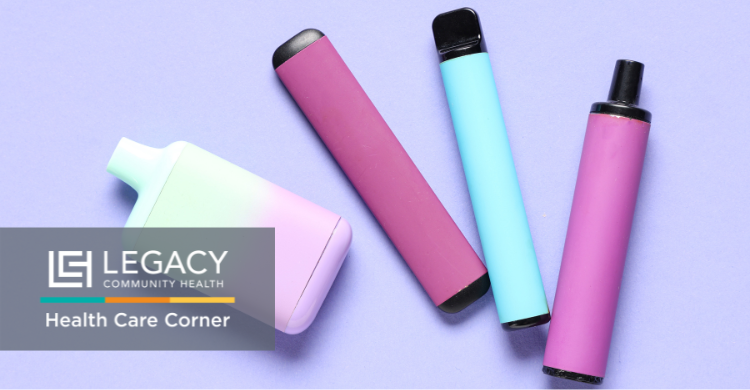
Here’s what we’re hearing from teens: “Yeah, I know vaping isn’t great. But I’m not addicted. I can stop whenever I want.”
The problem? Most of them can’t.
At Legacy Community Health, we’re watching a familiar pattern play out. Teens aren’t naive. They know vaping carries risks. What they don’t know is that knowing the risks doesn’t protect you from addiction. And by the time they realize they’ve crossed that line, quitting feels impossible.
The good news? It’s not too late, and quitting is possible with the right support.
What Are Teens Actually Inhaling?
E-cigarettes are now the most commonly used tobacco product among U.S. youth, according to the Centers for Disease Control and Prevention (CDC). Despite colorful packaging and candy flavors that suggest “harmless fun,” these devices deliver a highly addictive chemical that literally rewires developing brains.
According to Legacy Pediatrician Dr. Sarah Heathcote, one of the most dangerous misconceptions is that vaping is “just flavor.” In reality, “flavoring is just one of many ingredients in vape juice. Teens are often unaware that what they’re vaping may contain nicotine, THC, chemical additives, and trace metals,” she says. Certain additives can be particularly hazardous. For example, the addition of Vitamin E acetate in vape products was associated with serious vaping-associated lung injury.
We’re talking about the parts of the brain that control attention, learning, mood, and impulse control. These are the very things teens need to navigate school, relationships, and life decisions. When nicotine enters the picture during these critical development years, it doesn’t just affect the present. It sets the stage for the future.
Vaping devices aren’t just for nicotine anymore. They’re being used to inhale marijuana, synthetic drugs, and substances that teens often can’t even identify. Even as overall teen e-cigarette use declined in 2024, 1.6 million young people are still vaping. That’s 1.6 million too many.
How a “Harmless” Habit Becomes Something More
The path from casual vaping to substance use disorder isn’t a straight line, but the warning signs are there. Here’s what we’re seeing:
- Nicotine primes the brain for more. NIH research shows that adolescent nicotine exposure fundamentally changes how the brain experiences pleasure and reward. Translation? It makes the brain more vulnerable to other addictions down the road.
- It looks and feels like smoking, and that matters. The ritual is the same: hand to mouth, inhale, exhale. This familiarity creates a psychological pathway that makes trying cigarettes or other substances feel less foreign, less risky.
- Dual use is real. Some teens aren’t choosing between vaping and smoking. They’re doing both. This doubles down on nicotine dependence and exposes young lungs to even more toxins.
- Social settings matter. Vaping often happens in groups, at parties, in places where other risky behaviors are normalized. It’s not just about the device. It’s about the environment and peer influence that comes with it. Dr. Heathcote notes that common reasons teens start vaping include “curiosity, desire to fit in, stress, and boredom,” and emphasizes that keeping an active schedule, engaging in personal hobbies or interests, and staying involved with positive social connections may help reduce the opportunity or temptation to try vaping.
- Failed attempts fuel the cycle. NIH studies reveal that many youth who try to quit vaping struggle with relapse. Each failed attempt brings frustration, stress, and sometimes even more risk-taking as a coping mechanism.
What Teens Are Really Experiencing
Most say they want to quit. But they’re facing real challenges: cravings that hit out of nowhere, stress that feels unbearable without a vape, and friends who are still using.
Physical symptoms include:
- Shortness of breath and chronic coughing. Dr. Heathcote reports that “the most common physical symptom I see related to vaping in general is cough or exacerbations of asthma.”
- Anxiety, depression, and mood swings that seem to come out of nowhere
- Decreased appetite
- Brain fog and trouble concentrating in class
- Sleep problems that leave them exhausted
Dr. Heathcote also notes seeing cyclic vomiting and severe weight loss related to high levels of THC use specifically. “It may be difficult to determine to what extent vaping contributes to these symptoms; substance use can amplify these concerns and make recovery more challenging,” she says.
UT Physicians warns that vaping causes lung irritation and inflammation similar to traditional smoking and may expose users to toxic chemicals like formaldehyde. Meanwhile, MD Anderson Cancer Center points to long-term risks, including cancer, heart disease, and permanent lung damage.
These aren’t scare tactics. This is what’s happening to real teens right now.
What Teens Need
Teens are asking for help. But they’re not asking for lectures or judgment. They’re asking for:
- Real talk: factual education without the fear-mongering
- Peer support: hearing from others who’ve been there and quit successfully
- Confidential resources: places to get help without their parents, teachers, or friends finding out before they’re ready
- Stress management tools: healthy ways to cope with the pressures that made them start vaping in the first place
Help That Actually Works
The support landscape is getting better. Recent NIH-supported trials found that varenicline (a medication traditionally used for smoking cessation) may help teens quit vaping too.
Beyond medication, we’re seeing success with:
- Text-based programs like “This Is Quitting”: personalized encouragement and coping strategies delivered right to teens’ phones
- School-based initiatives: combining peer stories, rewards, and confidential counseling in safe spaces
- Digital support communities: social media groups that promote accountability without judgment
A Guide for Parents
When teens or parents come to Dr. Heathcote wanting help with quitting, her first response is to congratulate them for making the first step.
“Little can be accomplished without the internal desire for change, so the fact that they’ve recognized a problem and reached out for help is huge,” she says. “My advice at this stage is to keep lines of communication open and non-judgmental between the teen and parent or other caregiver. There may be ups and downs along the road to quitting, and trust in a support system for the teen will be vital to getting through challenges.”
Parents, you have more power than you think. Here’s where to start:
- Talk early and keep talking. Don’t wait for “the right time.” Keep conversations open, calm, and judgment-free. Dr. Heathcote stresses the importance of creating an environment where your teen feels respected and safe opening up to you about vaping and other sensitive topics. Avoid passing judgments or raising your voice if your teen says or does something you don’t agree with. Take a break and agree to return to a conversation later if needed so that you can keep a level head, prepare the message you want to express, or limit distractions. Check out CDC’s guide for parents for conversation starters.
- Know the signs. Sweet or fruity scents, sudden mood changes, increased thirst, nosebleeds, and USB-like devices hidden in backpacks or pockets.
- Create a tobacco-free home. Make your stance clear: vaping isn’t allowed, period. No exceptions, no “just this once.”
- Stay one step ahead. Learn about the marketing tactics that target teens, especially candy and fruit-flavored vapes designed to seem fun and harmless. Legacy TeenWell has resources to help you understand what you’re up against.
- Be a positive role model. Dr. Heathcote reminds parents that “your teen learns from your example, so strive to be a positive role model when it comes to vaping, effective communication skills, and healthy lifestyle habits.”
- Connect them with support. If your teen is struggling, encourage them to talk to a health care provider. Confidential help is available, and it works. Through our TeenWell® program, Legacy Community Health offers something that’s often hard to find: judgment-free care. Whether you’re a teen who wants to quit or a parent who wants to help, we offer:
- One-on-one counseling about vaping and addiction
- Workshops for parents and educators
- Confidential cessation resources for teens ready to quit
- A safe space to ask questions and get honest answers
We believe education is prevention. And prevention starts with conversation.
When We Work Together, Teens Win
Vaping might seem like a phase, or something teens will just outgrow. But for many, it’s the first step toward dependency, health problems, and struggles that can last a lifetime.
Here’s what we know for sure: when parents, educators, and health care providers work together, teens have a real chance at a healthier future. Because every teen deserves to breathe easier, literally and figuratively.
Learn more about vaping prevention and teen wellness at legacycommunityhealth.org/teenwell.

 HIV/STD Screening & Treatment
 OB/GYN