 Adult Medicine
 Behavioral Health
 Dental
 Endocrinology
 HIV/STD Screening & Treatment
 LGBTQ Services
 OB/GYN
 Pediatrics
 Pharmacy
 Senior Care
 Vaccinations & Immunizations
 Vision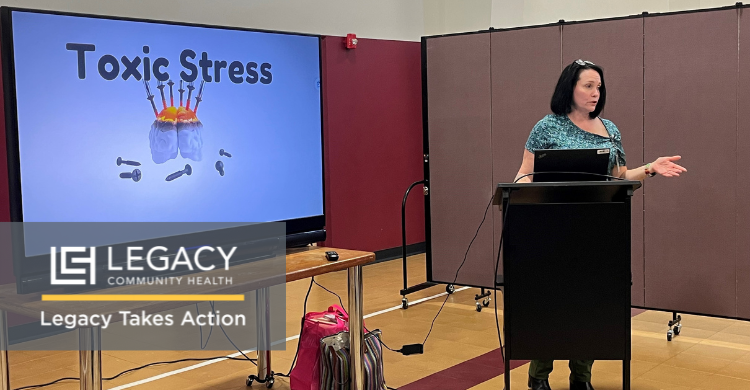
When Legacy Community Health talks about “Health Beyond Care,” we mean it’s what we’ve been doing for decades. Legacy has always been about more than clinical visits. We show up in classrooms and at community gatherings. We meet Texas families where they are. Then we partner with them through every stage of life.
One of the clearest examples of this commitment lives inside our Early Childhood Development program, Growing Great Minds. The person leading that work is Camarell Anderson, a Community Health Worker whose career has been shaped by one core belief. Prevention changes lives.
About Camarell Anderson
Camarell brings more than 20 years of experience in maternal and infant health to Legacy. She spent over a decade working in rural, underserved communities internationally as a direct-entry midwife. That experience taught her something that still drives her today. When you support families early, before problems take root, you can change the entire trajectory of a child’s life.
“When a family is in crisis, everything becomes about today,” Camarell says, “and that makes it harder to focus on what builds a child’s future.”
That philosophy is at the heart of Growing Great Minds. The program serves families with children from birth to age five through structured parent education classes and playgroups. It is not a diagnostic program, and it is not therapy. It is prevention, and that distinction matters.
The science backs this up. During the first three years of life, a child’s brain forms roughly one million neural connections every second. The experiences children have during this window shape their capacity for emotional regulation, learning, communication, and healthy relationships. Research from the Harvard Center on the Developing Child shows that it is far more effective and far less costly to build strong developmental foundations early than to try to fix problems later.
But not every family has the same access to the environments and resources that support healthy development. Social determinants of health — things like housing stability, access to nutritious food, neighborhood safety, and economic security — play a big role in how children develop. Families dealing with chronic stress from these pressures face additional challenges. When parents are stressed, their children feel it. And that can directly impact a child’s developing brain.
What Growing Great Minds Does
This is why Growing Great Minds can turn things around. The program brings parents and caregivers together in cohort-based groups that meet over eight weeks. Camarell designs and facilitates every session, covering topics like developmental milestones, emotional regulation, responsive parenting, resilience, and the science of toxic stress.
She also incorporates developmental screenings, motivational interviewing, and strengths-based goal setting so families leave each session with practical steps they can take.
The cohort model is important. A single workshop can introduce an idea, but it takes time and repetition for real behavior change to happen. Meeting over several weeks gives parents the chance to practice what they learn, ask questions, build trust with one another, and come back for support when something isn’t working. Many parents in these groups have told Camarell that just knowing other families face similar struggles made them feel less alone.
“When we combine support with information, parents are able to focus on building their child’s development instead of just reacting to problems,” Camarell says.
What makes Growing Great Minds different from many other family programs is its consistent focus on prevention. Camarell is clear that the goal is not to wait until a child is struggling in school or showing behavioral challenges. The goal is to give families knowledge and tools long before those challenges develop.
She teaches caregivers about serve-and-return interactions, where a child reaches out through a sound, a look, or a gesture, and a caregiver responds with warmth and attention. These simple exchanges are one of the most powerful mechanisms for healthy brain development, and they don’t require special toys or expensive programs.
Health Beyond Care in Practice
Families also benefit from partnerships across Legacy and with outside organizations to connect to the right services at the right time, whether that’s pediatric care, behavioral health support, or help with food and housing. Camarell works to strengthen those referral pathways so that no family falls through the cracks.
This is what Health Beyond Care looks like in practice. It is a Community Health Worker sitting with a group of parents on a Tuesday evening, talking through what to expect at each stage of their toddler’s development. It is developmental screenings offered outside of a doctor’s office. It is a mother learning for the first time that her child’s tantrums are a normal part of brain development, not a sign that she’s doing anything wrong.
Legacy’s Growing Great Minds program is currently running three cohorts per year, each serving approximately 20 families. If you are a parent or caregiver of a child under five and want to learn more about the program, visit our Early Childhood Development page or read our guide on developmental milestones.
You can also contact Camarell Anderson directly at canderson2@legacycommunityhealth.org or (832) 548-5229.
The best time to support a child’s future is right now. And at Legacy, we believe every family deserves the chance to build that future on a strong foundation.

 HIV/STD Screening & Treatment
 OB/GYN