 Adult Medicine
 Behavioral Health
 Dental
 Endocrinology
 HIV/STD Screening & Treatment
 LGBTQ Services
 OB/GYN
 Pediatrics
 Pharmacy
 Senior Care
 Vaccinations & Immunizations
 Vision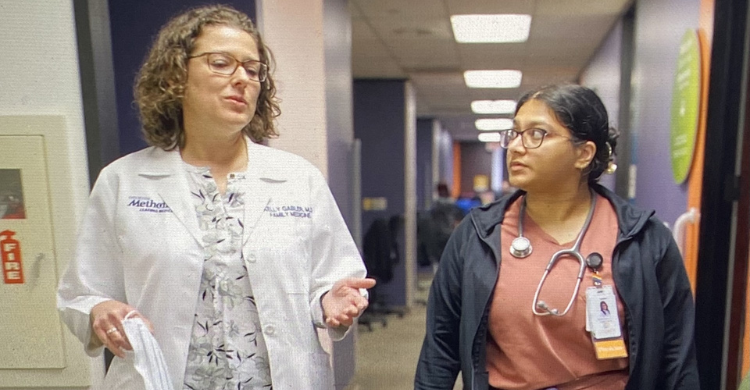
Twelve physicians-in-training now call Legacy Pasadena Southmore their clinical home, seeing patients, building relationships, and learning what it means to practice medicine in one of Houston’s most underserved communities. Behind that program is Dr. Kelly Gabler, and she has been working toward this moment for nearly two decades.
A native Houstonian who grew up in the Alief area, Dr. Gabler joined the faculty of what was then the San Jacinto Methodist Family Medicine Residency in Baytown in 2008 and became an employee of Legacy Community Health in 2013.
Since 2019, she has served as Program Director for that same program, now known as the Houston Methodist Family Medicine Residency, a role that brought her to planning meetings for Pasadena Southmore long before it had patients.
“It feels great to see patients in Pasadena, at this beautiful new clinic, where we can make an even more significant positive impact in the community,” she said.
The Road to Pasadena Southmore
The program has grown significantly since Dr. Gabler first joined its faculty. In 2015, the Baytown residency merged with a second program to create the combined 24-resident, three-year program that exists today, split evenly across two clinic sites. With the Baytown residency clinic closing, Pasadena Southmore stepped in as the new clinical home for half of those residents.
“Legacy recognized that there is a lot of unmet need for comprehensive continuity healthcare in the Pasadena area,” Dr. Gabler said. “Coming to this community, where we can work together to meet those medical needs and build healing relationships, is the perfect next step in the evolution of the residency program.”
What Continuity Care Means for Pasadena Patients
For Dr. Gabler, everything comes back to continuity. In practice, it means something simple but is genuinely uncommon in community health settings. Patients see the same physician every visit. The Accreditation Council for Graduate Medical Education (ACGME), the national board that oversees residency training in family medicine, places it among the highest priorities of any program. Residents are assigned to a clinic in their first year and remain there through graduation, building a panel of patients and developing relationships that deepen over time.
Dr. Gabler has seen what that consistency makes possible. “Patients who have had trouble adhering to a treatment regimen often gain confidence taking all medications correctly with the coaching of a primary care physician who knows them well,” she said. “I have also seen patients willing to open up about domestic violence or mental health concerns they had previously kept to themselves because they had grown to trust their continuity family physician, and this allows us to get them the help they need.”
That kind of relationship, she said, provides that familiarity and ability to know the whole person and not as an encounter. It is central to Legacy’s mission, and it is now available to the Pasadena community.
Who Are These Residents?
The residents at Pasadena Southmore are fully licensed physicians who have completed medical school and earned their degrees. During their three-year residency, they further develop their clinical skills under the supervision of experienced faculty, and that supervision begins immediately.
“Starting day one, they see patients themselves,” Dr. Gabler said. The faculty includes Dr. Gabler and her fellow Legacy-employed physicians, who are directly involved in every patient visit during the first six months and remain closely engaged throughout all three years. The oversight is substantive, and the quality of care patients receive reflects that.
The Investment Behind the Program
The partnership supporting this program has a long foundation. Houston Methodist’s relationship with Legacy dates to 1998, and the $50 million donation Houston Methodist made to Legacy in 2021 was the largest gift in Legacy’s 40-year history, designated specifically to expand care in underserved communities, including Pasadena.
According to the Health Resources and Services Administration, the United States is projected to face a shortage of more than 87,000 full-time primary care physicians by 2037. Training physicians inside a Federally Qualified Health Center like Legacy shapes the values and priorities these residents carry for the rest of their careers.
The Pasadena Southmore Clinic also brings capabilities that were not previously available. On-site imaging, a clinical pharmacy expected to open this summer, and dental services to follow mean fewer barriers for patients and a richer training environment for residents. The difference is already showing up in real time.
“Just last week, one of the residents’ patients was able to get an X-ray in real time, and we were able to quickly diagnose a broken arm before he left his appointment,” Dr. Gabler said.
A Commitment That Carries Forward
For Dr. Gabler, the road ahead is as clear as the one behind her.
“Providing preventive services to patients of all ages and caring for pregnancies, acute illnesses, and chronic diseases is a privilege,” she said. “Pasadena is such a vibrant community, which I am excited for us to join. As our residents strengthen their clinical skills by serving the community, I know Legacy’s presence will improve the health of Pasadena for years to come.”
At Legacy, Health Beyond Care is not a tagline. It is a belief that healthcare should extend beyond clinical visits to support whole-person and community health — for every patient, regardless of their race, ethnicity, gender identity, sexual orientation, or ability to pay. Dr. Gabler and her residents are proof of that belief in action.

 HIV/STD Screening & Treatment
 OB/GYN